For many American students, the back to school season means buying textbooks, finalizing their semester schedules, and getting their dorm set up just the way they want it. For others, it means taking a gap year.
Gap years are often misunderstood. Many people assume that students who take a gap year spend the entire year sleeping until noon, playing video games, and hanging out with friends. But if done responsibly, gap years are more about experiential learning.
This is why so many young adults with the opportunity to take a gap year spend it traveling. If you’re ready to make the world your classroom this fall, you don’t want to leave home without gap year travel insurance.
Travel Insurance for All Gap Year Travelers
As with any travels abroad, it is recommended to consider the possibility of purchasing travel insurance in case of a medical emergency or if you want extra protection for your flights and baggage. Whether you are a seasoned traveler or if it is your first time traveling by yourself, gap year travel insurance can ease and protect you from the stress of potential travel mishaps that can happen, allowing you to enjoy your trip abroad.
There are certain travel insurance plans that benefit every traveler, no matter why they’re traveling or what kind of activities they’ll be doing. Here’s a rundown of coverage that will benefit every gap year traveler.
Travel Medical Insurance
When traveling abroad, there can be some uncertainty around medical care especially in an unfamiliar place with no insurance. That’s why no gap year traveler should leave home without suitable travel medical insurance. Travel medical insurance can offer protection in the event that you become ill or are injured during your travels. When you buy travel medical insurance, you may also be covered for a number of other things like lost passports assistance, 24-hour emergency assistance, border entry protection, personal liability and more.
Trip insurance With Cancel For Any Reason Coverage
Trip insurance is a subset of travel insurance that provides coverage for your nonrefundable and paid in advance costs related to various trip mishaps. If your flight’s been interrupted, delayed or canceled for a covered reason, you’ll be able to recoup some related expenses. If your baggage is lost, damaged or delayed, trip insurance helps you cover those associated costs too. Don’t let potential travel surprises derail your gap year travel experience. Trip insurance can help keep your journey on track.
Customize Your Travel Insurance
The beauty of a gap year is that it can be customized to each traveler. If your gap year travel plans include more specific activities, you can customize your travel insurance to suit your specific needs.
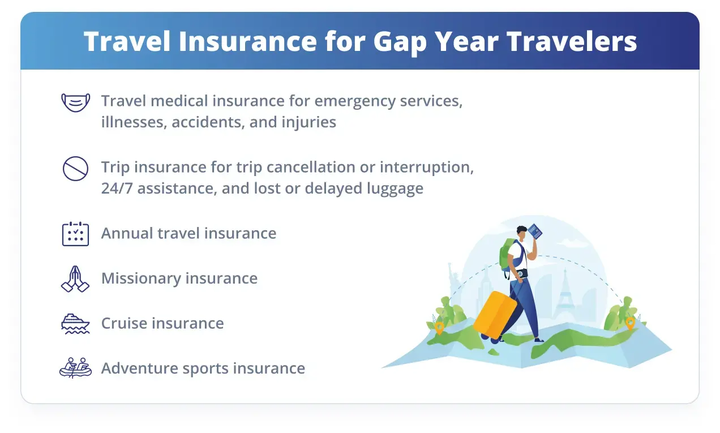
Travel Insurance for Gap Year Travelers
The beauty of a gap year is that it can be customized to each traveler. If your gap year travel plans include more specific activities, you can customize your travel insurance to suit your specific needs.
Cancel For Any Reason (CFAR) Insurance
Cancel For Any Reason insurance (CFAR) can be added to your standard trip insurance plan and gives you the flexibility to cancel your trip for literally any reason. With CFAR, you can still receive compensation for eligible prepaid expenses like nonrefundable lodging, transportation, and unused event or tour tickets.
Typically, CFAR recovers 50-75% of your nonrefundable prepaid trip costs when canceling for reasons that are not covered by standard policies. This means, for example, if you’ve invested $5,000 in non-refundable expenses and have CFAR insurance, you could receive around $2,500–$3,750 back, no questions asked, an amount that would otherwise be completely lost.
Annual Travel Insurance
If you’re planning on traveling in several countries throughout the year, annual trip travel insurance (also called multi-trip travel insurance) is a very convenient way to stay protected for the length of your travels. You can choose either a 30-day or 45-day coverage duration. What this means is that you can take as many trips as you want within the duration you chose before having to come back to your home country.
So if you opt for 45 days, on Day 46 you would no longer be covered. However, once you come back home the 45-day duration resets, so the next time you travel within the same year, you’ll be covered for another 45 days. With multi-trip insurance, you’ll only pay the premium once, so it’s also more cost-effective than buying a separate policy for a few separate trips throughout the year.
Cruise Insurance
Dreaming of taking a cruise during your gap year? As you book your flight and lodging accommodations, it’s especially important to think about travel insurance. Cruise-specific travel insurance is even more important in light of the Delta variant surge.
While major cruise lines are taking COVID-19 safety precautions, cruise ships can be especially vulnerable to a viral outbreak and they often lack the resources to handle major medical events. That’s why one of the cornerstones of cruise insurance is emergency medical evacuation. This benefit covers costs associated with an airlift to the nearest hospital and subsequent medical care.
If you miss your ship’s departure, you don’t have to let it ruin your whole trip. Cruise insurance also covers costs associated with getting you to the next port so you can reunite with the ship.
Adventure Sports Insurance
If you’re planning hiking or mountain-climbing, jet skiing or scuba diving, or participating in any other higher risk sports during your gap year, buying adventure sports coverage is not only smart, but it might just save your life. Your basic travel insurance might not cover these exciting-but-risky sports simply because of the danger involved. Adventure sports insurance ensures that you get the medical care you need if your fun outing takes a turn.
If you’ll be participating in high-risk activities in hard-to-reach locations, it’s a good idea to add emergency medical evacuation coverage to your travel insurance, just in case. If you suffer an injury and need to be evacuated to receive medical care, without insurance, an airlift alone would cost thousands of dollars. Paying a little extra up front for emergency medical evacuation coverage not only gives you peace of mind, it can also save you a lot of money.
Missionary Insurance
Spending your gap year volunteering is an admirable use of your time and talents. If you’re connected with a faith-based organization, you may want to consider missionary insurance. This type of coverage helps cover representatives of certain qualified faith-based organizations as they travel to remote areas to help people in need.
If you’re doing missionary work, chances are you’ll be in an area with fewer resources to treat medical emergencies. If you suffer an injury or illness while abroad in a more remote area, you’ll be glad you bought emergency medical evacuation insurance. This benefit covers the cost of not only being airlifted to a nearby hospital (a procedure that would cost you thousands of dollars without travel insurance) but also the cost for the medical treatment.
Protect Yourself During Your Gap Year Travels
Spending your gap year traveling is a great way to experience the world firsthand and gain a new experience before heading back to the classroom. Suitable travel insurance coverage adds security so you can travel freely and more confidently around the world.
Have questions? That’s what our Customer Success Team is there for. If you need assistance, please don’t hesitate to reach out or see our Ask the Experts section to view more answers to frequently asked questions.
Frequently Asked Questions (FAQs)
How much does travel insurance typically cost?
Generally, travel insurance costs around 4% to 10% of your trip’s prepaid, nonrefundable expenses. For example, if your trip expenses in total cost around $4,000, you can expect to pay about $160-$400 for trip insurance. Many times, travelers end up getting a good trip insurance policy for just around $110-$200, however, the cost isn’t a one-size-fits-all number.
The cost of travel insurance depends on several factors, like your trip cost, age, how long you will be at your destination, location, number of travelers, and if you add on any other benefits like Cancel For Any Reason (CFAR), Interruption For Any Reason (IFAR), or pre-existing medical condition waivers.
Do I need to list each and every destination I go to?
You can select any one of your planned destinations while purchasing a trip insurance plan. It is recommended to select the one you’ll spend the most time in. However, trip insurance covers all prepaid, non-refundable trip costs during the coverage dates, including those from different destinations. For example, if you spend two weeks in France and then one week in Switzerland, you should select France as your main destination. Regardless, the policy will cover your prepaid, non-refundable expenses for both countries during your trip dates.
Does trip insurance cover traveling with expensive items like cameras or my laptop?
Trip insurance can provide coverage for high-value items like cameras and jewelry. Typically, there are per-item and overall maximum benefit limits. Make sure to read your plan documents to understand the full details of what is covered and to what extent, since every plan is unique. Also consider purchasing additional specialty insurance for expensive electronics, jewelry, or sports equipment.
How precise should my trip cost calculation be?
You should always input the exact amount for your trip cost. If you go a little under, it can make you ineligible for certain benefits. It is best to round to the nearest dollar when inputting your prepaid nonrefundable trip costs, but make sure to check your receipts or documentation of purchase.
Does coverage start when I leave home, or only once I arrive at my destination?
As long as your policy start date is correctly stated to the day you leave for your trip, coverage should start the moment you leave your home. This start date is important, that way you have ultimate coverage in case of any mishaps on your way to your flight or cruise, as well as potential airport situations like a trip cancellation.
When should I buy my travel insurance?
It is recommended to purchase a policy plan around the same time you book your trip. That way, you have strong coverage for your accommodations and overall trip so you can prepare with more confidence. Additionally, purchasing travel insurance in a timely manner can unlock benefits such as Cancel For Any Reason (CFAR) insurance and pre-existing condition waivers, both which are typically accessible only within 14-21 days of your initial deposit.
Is travel insurance more expensive for international trips?
Not necessarily. The cost of your travel insurance is dictated by what it has to cover. If your trip costs more or you choose higher coverage limits, then your plan will reflect that. Since international trips tend to cost more and require higher coverage, your travel insurance can cost more. But, ultimately, your destination is not what directly affects the cost of your travel insurance.
What is the claim process like?
Filing an insurance claim can be quick and easy. First, it is important to contact your travel insurance provider as soon as possible to get started. Make sure you have gathered all necessary documentation, such as receipts, medical records, or proof of cancellations, and submit a completed claims form along with these supporting documents online or by mail. Each provider may have slightly different procedures when it comes to a claims process, so it’s important to check your insurance policy, or reach out to customer service for guidance who are more than happy to assist you. Keeping copies of everything and acting fast can help the process go as planned.
For any guidance about filing a claim, our Claims Assist Specialists are available to guide you through every step.